SASOHN “VISION”
To continue to be a recognised leading professional practice society that promotes the occupational health nurse practitioner and advances both national and international standards in occupational health in order to improve and sustain the quality of occupational health services.
SASOHN MISSION STATEMENT
To protect the profession by making representation and influencing decision making at local, national and international forums that will have a positive impact on occupational health
To advance the profession by continuous professional development (CPD), networking to enhance knowledge and provide peer bench-marking practices.
Promoting the profession through branding that emphasises the value of the occupational health practitioner.
SASOHN VALUES
Professionalism:
Professional approach in all our business dealings and interpersonal relationships
Respect
Respect each other and value diversity in ideas, work style, background, and skills
Integrity
Integrity, honesty and ethical approach and skills
Delivery
Delivery and results-driven culture through constructive feedback and continuous improvement
Excellence
Excellence and efficiency in the way we deliver our service
SOCIETY OBJECTIVES
To promote, encourage adherence and delivery of high standards rendered in all occupational health practices,
To professionally develop and empower the Occupational Health Nurse Practitioner,
To enhance effective governance and sound ethics for Occupational Health Nursing Practice,
To provide a forum for the exchange of information, experiences and effective solutions on matters of common and relevant interest to members,
To promote and protect the corporate identity of SASOHN
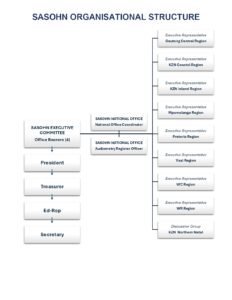
ORGANISATIONAL STRUCTURE
About SASOHN
History of SASOHN
From a small discussion group in 1966 to a nationally recognised professional society — the story of Occupational Health Nursing in South Africa.
20 April 1966
Industrial Nurses of the then Southern Transvaal held their first meeting, arranged by Mary E Ahlers, who worked for the United Tobacco Company Ltd.
11 April 1970
The first Occupational Health Nurses Discussion Group (Southern Transvaal) was officially held. Founders included M.E. Ahlers, D. Cas, C.A. Robertson, M. Dixon, A.M. Coetzee, M.G. Meeker, E. Smith, A. Shacklock, and D. Blacklaws.
1976
Members became involved in accommodating nursing students in basic and post-basic occupational health speciality courses. The term “Industrial Nurses” was changed to “Occupational Health Nurses” to align with international standards. Concerns were raised about indemnity cover, and Occupational Health Nursing education and Audiometry training were formally recognised.
2 June 1976
22 nurses enrolled for the first Certificate in Occupational Health Nursing course, run by Professor Ian Webster at the National Centre for Occupational Health.
1977
The first Occupational Health Nursing Certificate course through a university was arranged by the University of Port Elizabeth.
1979
S. Coetzee initiated a course using the boardroom of the South African Nursing Association for lectures in Pretoria.
30 April 1980
The South African Society of Occupational Health Nurses (SASOHN) was formally established, driven by E. Snyman and S. Coetzee, who recognised the need to promote occupational health nursing in South Africa. S. Coetzee was elected the first President.
9 July 1981
SASOHN’s first Annual General Meeting (AGM) was held in Pretoria.
7 October 1981
SANC formally recognised the additional qualification in Occupational Health Nursing (OHN).
1983
All discussion groups changed their names to Professional Societies of SASOHN.
1990
Following discussions with the Rector, H. Snyman and J. Serfontein, courses were commenced at the Port Elizabeth Technikon.
7 March 2001
SASOHN was awarded custodianship of the Audiometry database by the Department of Labour.
2003
The SASOHN National Office was launched, initially operating two hours a day, and has since grown to a half-day position due to the increasing volume of work.